P-ELRS Full-Band Communication Module
A six-band RF communication module covering 180/270/470/680/990/1780 MHz, for UAV control links, long-range telemetry and link redundancy in complex RF environments.
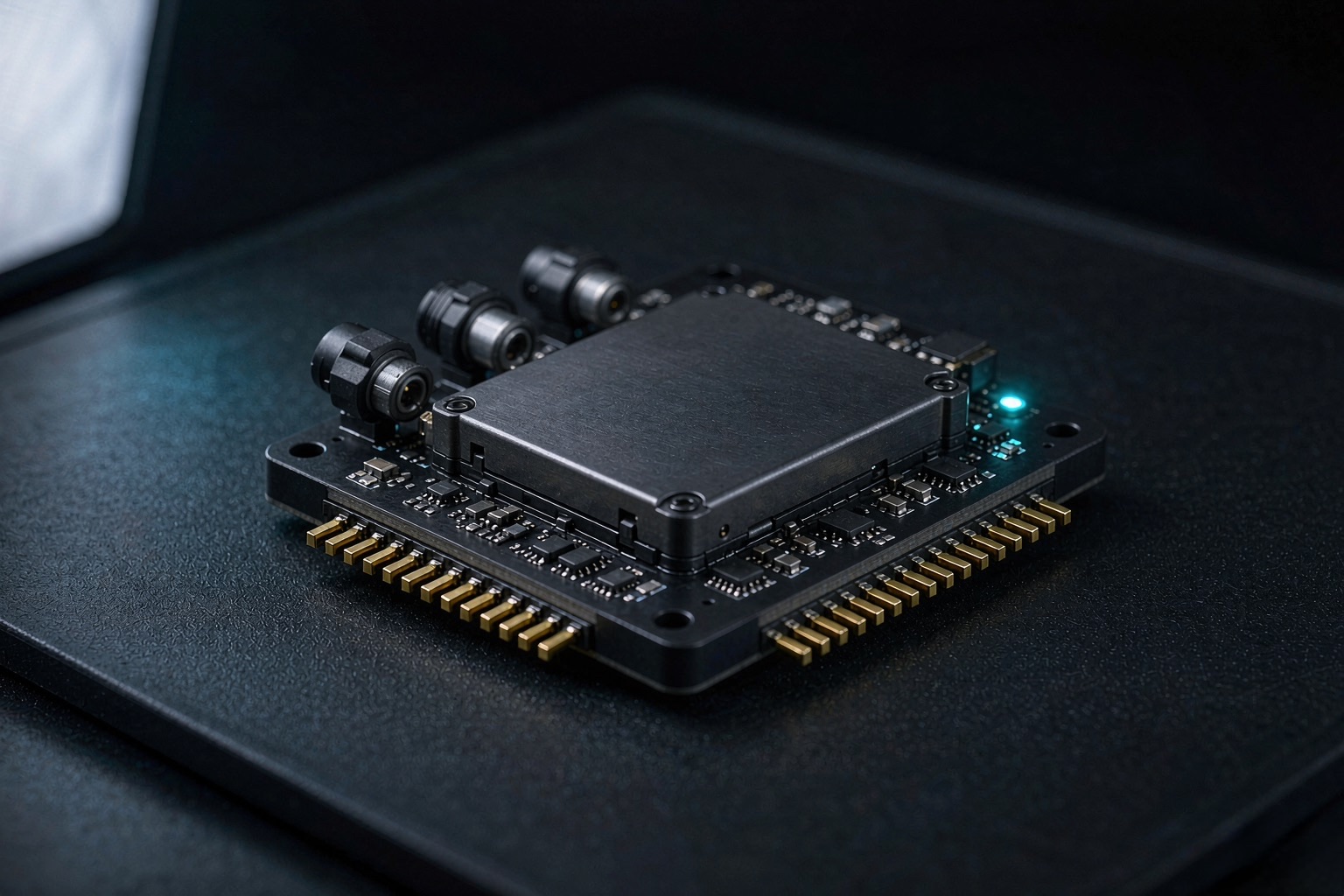
Positioning
Spectrum in industrial environments is rarely clean. Urban structures, industrial sites and forested terrain all constrain the 2.4 GHz band that most consumer-grade control links depend on. P-ELRS covers six separate frequency bands, so the operating frequency can be selected in hardware or software, or scanned across bands when conditions change.
It fills three roles: primary control link, long-range telemetry, and redundant backup link. In a dual-link configuration the aircraft remains controllable if the primary path degrades.
Key specifications
| Parameter | Value |
|---|---|
| Supported centre frequencies | 180 / 270 / 470 / 680 / 990 / 1780 MHz |
| Band selection | Hardware or software selectable, multi-band scan supported |
| RF front end | Integrated LNA, power amplifier, filtering and switching |
| Transmit power | Software and hardware adjustable; high-power and low-power modes |
| Receiver | High sensitivity, wide dynamic range |
| Anti-interference | Built-in filtering, dynamic spectrum sensing, intelligent frequency hopping |
| Extension | Supports external anti-interference module and antenna feedline isolation |
Band coverage and link performance depend on the antenna fitted, local regulations and the operating environment. Transmission distance and refresh rate are not stated here because they vary by band, antenna and site conditions — ask us for figures relevant to your frequency plan.
Why multi-band matters
| This module | Typical single- or dual-band ELRS modules | |
|---|---|---|
| Band coverage | 180–1780 MHz, six bands | Usually 2.4 GHz and/or 915 MHz |
| Band selection | Per mission, or scanned | Fixed at manufacture |
| Typical application | Complex terrain, industrial sites, multi-environment survey | Consumer FPV, civil aerial photography |
| Refresh rate | Varies by band | 2.4 GHz versions commonly reach 500–1000 Hz |
Low bands such as 180 MHz suit short-range links with better penetration; 990 MHz balances penetration against range; high bands suit unobstructed long-range links.
Antenna selection matters as much as the module: fit an antenna matched to the band, or a wideband antenna for multi-band work.
Deployment
- Control link — primary or secondary radio link
- Telemetry — long-range mission data downlink
- Redundancy — paired with a second module for link redundancy
- Fixed installations — ground station or relay coverage
What to confirm before ordering
- Target bands and the local frequency authorisation that applies
- Antenna type and mounting position, and feedline length
- Whether dual-module redundancy is required
- How the link relates to any existing control link — primary, backup or parallel
- Whether an external anti-interference module is needed
Frequently asked questions
Can the P-ELRS be configured for a specific mission?
Yes. The P-ELRS is configured to the mission rather than sold as a fixed package: payload combination, data link, power and mechanical interfaces are settled before the order, and acceptance criteria are agreed before work starts.
Under what conditions were the specifications measured?
The table gives typical-condition values. Actual figures depend on payload, wind and dispatch pattern; per-item conditions are confirmed with the project.
How are price and lead time given?
There is no published price list. Pricing follows configuration and quantity; production is scheduled against orders, and lead time is confirmed with the order.