H-100 Heavy-Lift Multirotor
A 100 kg payload coaxial eight-rotor multirotor with 20 km range and manned-capable control modes. Full specifications, interfaces and the certification position stated on the page.
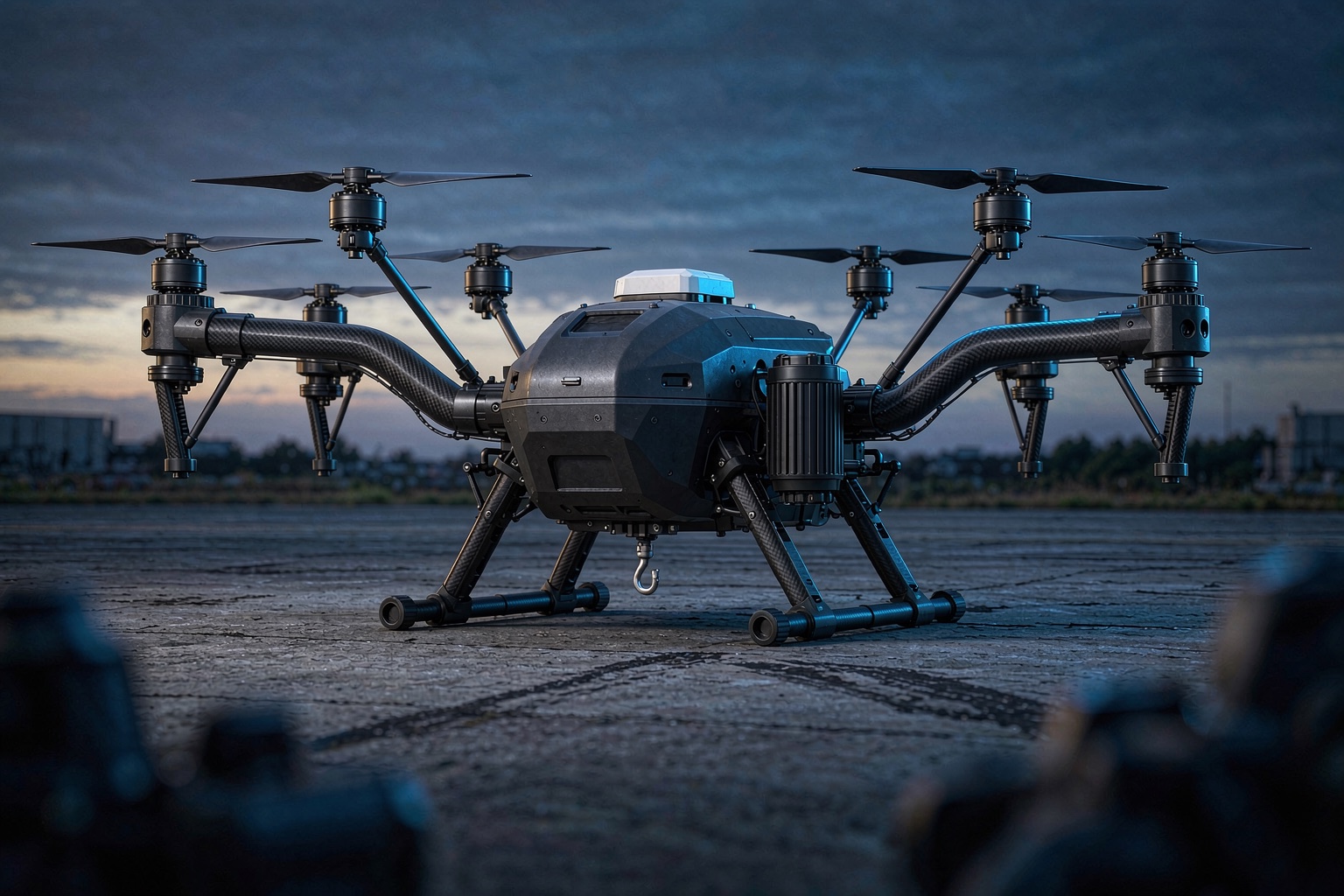
Positioning
H-100 is a large coaxial eight-rotor multirotor built for heavy payload operations where carrying capacity, endurance under load, and structural redundancy matter more than compactness. The airframe accepts a seated occupant or mission equipment in the central cabin, and it supports both onboard piloted control and ground remote control.
The eight-motor coaxial arrangement means a single- or dual-motor failure does not immediately remove lift. Power is distributed through a high-current bus with pre-charge and emergency stop, and battery packs are removable for turnaround between missions.
Specifications
| Parameter | Value |
|---|---|
| Configuration | Four-arm coaxial eight-rotor (X8), 46-inch carbon propellers |
| Diagonal dimension | 3,520–3,560 mm |
| Footprint diameter | 3,170–3,200 mm |
| Landing gear track | 800–1,000 mm |
| Landing gear wheelbase | 900–1,100 mm |
| Central cabin (external) | 650 × 650 × 250 mm (L × W × H) |
| Avionics / battery bay | 500 × 500 × 200 mm (L × W × H) |
| Payload deck height | 450–550 mm |
| Empty weight (excl. battery) | 55–70 kg |
| Battery weight | 50–80 kg |
| Payload | 100 kg |
| Maximum take-off weight | 200–220 kg |
| Disc loading | ≤20 kg/m² |
| Motor | 8× brushless outrunner, 100 KV class; peak 6–7 kW each, torque peak ≥30 N·m |
| ESC | 8× 200–220 A continuous, peak ≥300 A, FOC, current and temperature telemetry |
| System power | Peak 40–55 kW (10–15 s); cruise 18–26 kW |
| Power bus | Copper 4 × 40 mm, equivalent continuous ≥800 A |
| Main connector | QS10 / AS150U (dual in parallel) |
| Protection | 800 A slow-blow fuse + pre-charge (50–100 Ω / 50 W) + mechanical emergency stop |
| Battery | 20S nominal 74 V (84 V full), 10–15 kWh, 135–180 Ah, high-rate |
| Battery packs | 2–4 packs, parallel capable; 1–2 additional packs supported |
| Ground power | Supported, external supply for test and turnaround |
| Endurance (full payload) | 20–30 min, typical conditions |
| Range | ≥20 km, subject to load, weather and dispatch |
| Mission energy | 450–650 Wh/km, depending on wind and dispatch |
| Cruise speed | 45–65 km/h |
| Climb rate (full load) | 1.0–1.5 m/s |
| Practical ceiling | 300–500 m AGL |
| Noise | 85–95 dB |
| Takeoff and landing | Vertical, no runway required |
| Flight control | PX4 / Ardupilot / QGC / Mission Planner compatible |
| Control modes | Onboard piloted and ground remote |
| Remote link | 2.4 GHz / 900 MHz / configurable; 5–10 km line of sight |
| Wired control station | Optional, for engineering test and special operations |
Certification and compliance
Manned flight requires regulatory approval in every jurisdiction where it is flown, and those approvals are granted to the operator, not supplied with the aircraft. We provide the technical documentation your application needs. Operating limits, emergency procedures and crew requirements come from the approved documentation for your operation.
Payload integration
Payload integration starts with three checks: weight and balance must sit within the deck load limit and stay inside the balance envelope; payload draw must fit the remaining bus capacity including peak current; and signal type, bandwidth and timing must match the avionics interfaces.
Information needed for a quotation
- Payload weight and dimensions, including mounting hardware
- Required endurance or range, and the operating environment
- Sensors to be integrated and their data interfaces
- Whether onboard piloted control, ground remote control, or both
- Jurisdiction of operation
- Quantity and timeline
Frequently asked questions
Can the H-100 be configured for a specific mission?
Yes. The H-100 is configured to the mission rather than sold as a fixed package: payload combination, data link, power and mechanical interfaces are settled before the order, and acceptance criteria are agreed before work starts.
Under what conditions were the specifications measured?
The table gives typical-condition values. Actual figures depend on payload, wind and dispatch pattern; per-item conditions are confirmed with the project.
How are price and lead time given?
There is no published price list. Pricing follows configuration and quantity; production is scheduled against orders, and lead time is confirmed with the order.
Does Montline provide type certification?
No. Airworthiness certification and operational approval are the operator's responsibility; Montline does not provide type certification.